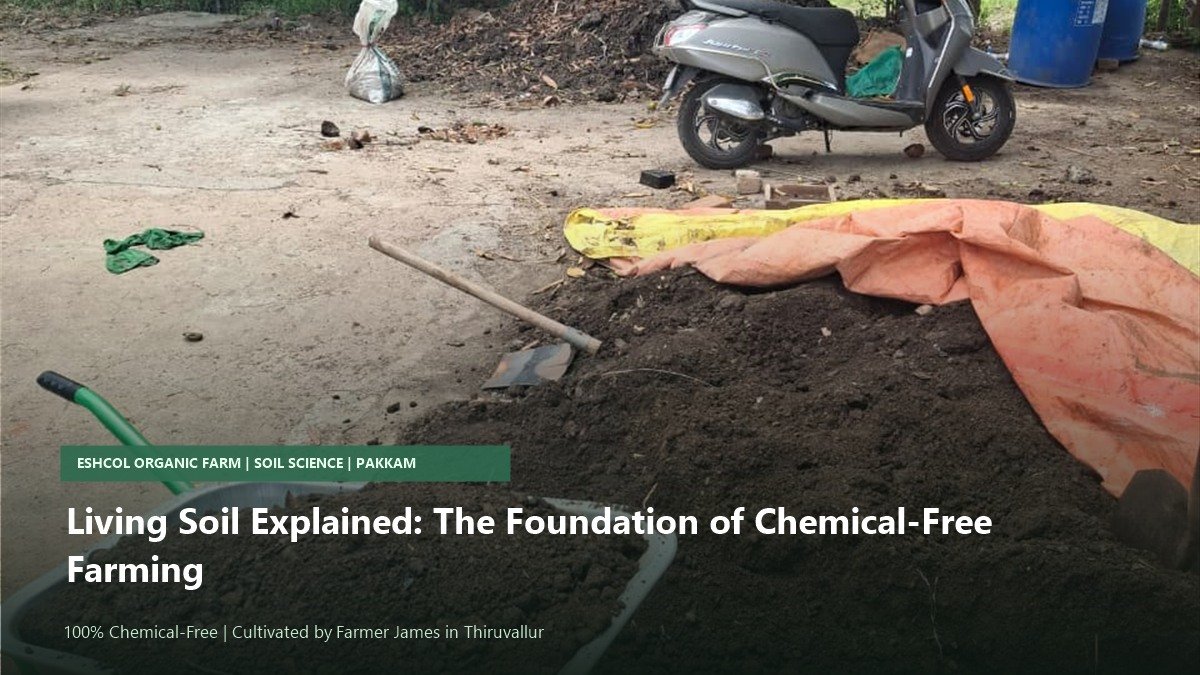
In conventional commercial farming, soil is treated merely as an inert anchor that holds plant roots while synthetic chemicals are piped in. In contrast, genuine organic farming soil health Chennai principles recognize that soil is a living biological ecosystem containing billions of microscopic organisms per handful.
At Eshcol Organic Farm in Thiruvallur, Farmer James centers every farming practice around living soil enhancement. Here is how living soil creates naturally disease-resistant crops.
1. The Soil Food Web and Nutrient Cycling
When organic matter such as cow dung, dry leaf mulch, and legume residues are added to the field, soil microorganisms digest these materials. Beneficial bacteria and mycorrhizal fungi establish symbiotic relationships with vegetable roots, trading minerals like phosphorus and potassium for plant carbohydrates. Plants receive balanced nutrients at the precise rate they require, preventing the watery cell walls caused by synthetic nitrogen fertilizer.
2. Earthworms: The Natural Soil Engineers
A simple test of soil health is counting earthworm casts. Earthworms consume organic matter and soil particles, excreting nutrient-rich vermicast containing concentrated calcium, magnesium, and available nitrogen. Their burrowing action creates microscopic tunnels that aerate the root zone and allow monsoon rainwater to penetrate deep into groundwater reserves rather than washing away as surface runoff.
3. Moisture Retention During Hot Chennai Summers
Soil enriched with organic matter acts like a biological sponge. Every one percent increase in soil organic carbon dramatically expands water-holding capacity. During hot weather in Tamil Nadu, our living soil fields retain moisture significantly longer than chemical-hardened neighbor fields, reducing irrigation requirements and keeping plant roots cool.
Living Soil vs Chemical-Treated Soil
| Feature | Living Organic Soil | Chemical-Treated Soil |
|---|---|---|
| Microbial Diversity | High count of beneficial fungi, bacteria, and earthworms. | Depleted by synthetic fertilizers and fungicide drenches. |
| Structure | Porous, crumbly aggregation that absorbs rainwater. | Compacted and crusted, prone to heavy erosion. |
| Plant Resilience | Natural systemic immunity against root rot and wilt. | Dependent on frequent synthetic chemical treatments. |
Frequently Asked Questions
How does Eshcol Farm build living soil?
We combine seasoned cow manure, farm compost, continuous bio-mulching, and legume crop rotations to sustain active organic carbon in our Thiruvallur fields.
Can I see the living soil during a farm visit?
Yes. We encourage visitors on our educational field visits to examine our soil beds and compost systems firsthand.